



















Russia had barely reopened the Crimean Bridge after Monday’s attack when another strike forced it to shut the entire crossing. By Tuesday morning, November 17, both road and rail traffic had stopped, and new footage suggested that one of the bridge’s massive arches had collapsed into the sea.
Russia’s Transport Ministry confirmed that the bridge, which connects Russia to occupied Crimea across the Kerch Strait, was attacked for the second time in two days. The ministry suspended all vehicle and train traffic while authorities assessed the damage. Drivers were advised to avoid the crossing.
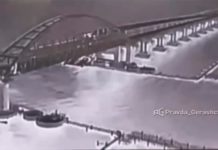
Photographs and videos circulated by the Russian independent outlet ASTRA and Ukrainian monitoring channels Supernova+, Exilenova+ and Crimean Wind appear to show only one of the bridge’s two large arches still standing. The channels reported that the other arch and a section of the roadway had fallen into the water, according to Ukrainska Pravda.
Did One of the Crimean Bridge’s Arches Collapse?
The footage has raised serious questions about the structural condition of the crossing.
Images shared after the overnight attack appear to show a missing arch and substantial damage to the road section. If confirmed, the collapse would represent a far more serious blow to the bridge than Russian officials initially acknowledged after the first strike.
However, the full extent of the damage has not been independently verified. The Associated Press could not confirm reports that a bridge span had collapsed, while Reuters reported that the severity of the latest damage remained unclear.
Russian authorities have acknowledged the disruption but have not provided a detailed public assessment of the damaged structures or a timetable for reopening.
Two Attacks in Less Than 48 Hours
The first strike occurred on the morning of November 16, when Russian-installed authorities in Crimea reported an attack and restricted vehicle traffic.
Early reports suggested that one of the bridge’s arches had suffered damage. The Kremlin played down the incident, with Russian officials describing the damage as minor.
By Monday evening, Russian Deputy Prime Minister Marat Khusnullin announced that one road lane had reopened. Vehicles could pass in alternating directions, while trains continued to operate.
That reopening proved short-lived.
During the night of November 16–17, the bridge came under attack again. Sergei Aksyonov, the Russian-installed head of occupied Crimea, confirmed the second strike and announced another suspension of traffic.
This time, Russia closed both the road and railway sections.
Were Ukrainian Flamingo Missiles Used?
Questions have also emerged about the weapons involved in the second attack.
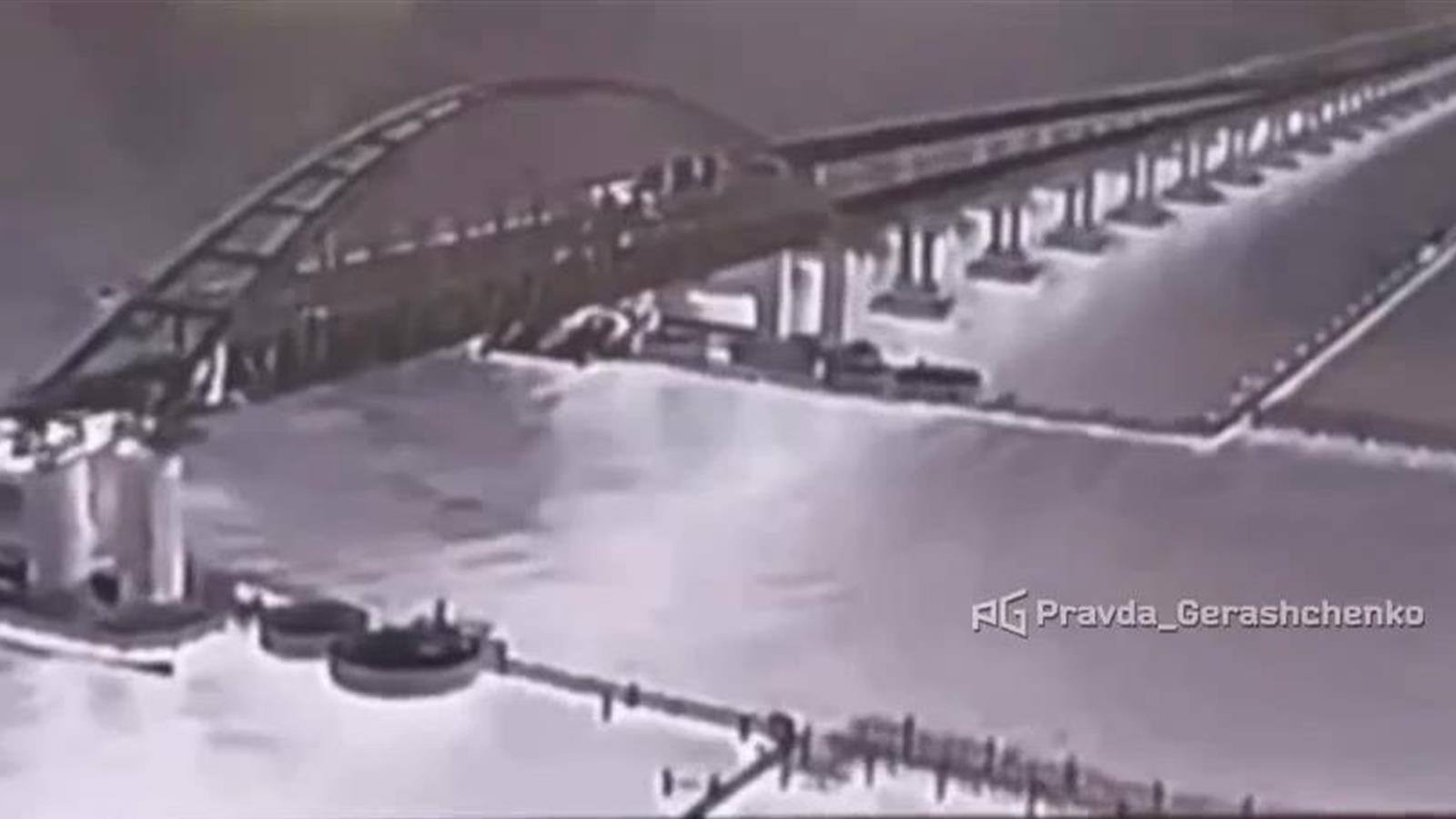
Russia’s Transport Ministry described the incident as a drone attack. However, separate reports suggested that Ukrainian FP-5 Flamingo cruise missiles may have struck the bridge.
Denys Shtilierman, co-owner of Ukrainian defense manufacturer Fire Point, shared a post by former Ukrainian official Anton Herashchenko that featured footage purportedly captured by a missile-mounted camera during its final approach to the crossing.
The footage was presented as showing a Flamingo missile shortly before impact. However, the weapon’s identity and its role in the attack have not been independently confirmed.
Why the Crimean Bridge Matters to Russia’s War
The 19-kilometer (12-mile) bridge is one of Russia’s most important transport connections to occupied Crimea.
Beyond civilian travel, the crossing has served as a supply route for Russian military forces. Its railway and road sections allow Moscow to move equipment, personnel and other supplies toward the peninsula and Russian-occupied territory in southern Ukraine.
The bridge also carries considerable political significance. Vladimir Putin promoted it as a flagship infrastructure project after Russia illegally annexed Crimea in 2014.
The crossing suffered major attacks in October 2022 and July 2023, which forced Russia to undertake extensive repairs.
A prolonged closure could complicate Russian military logistics and place additional pressure on alternative transport routes. However, the bridge is not Russia’s only supply connection to the occupied peninsula.
The latest damage assessment will determine how quickly traffic can resume.
For now, one result is beyond dispute: after two strikes in two days, Russia has halted all traffic across one of its most strategically important connections to occupied Crimea.
 Додавайте "Україна Неймовірна" у свої джерела Google Новини