















Ukrainian President Volodymyr Zelenskyy has urged NATO members to consider full Ukrainian membership as an alternative to separate postwar security guarantees. Addressing the NATO Parliamentary Assembly in Berlin on November 23, he argued that joining the Alliance could offer a more effective, potentially less costly and more reliable framework for protecting Ukraine. NATO Secretary General Mark Rutte, however, acknowledged that Allies have yet to reach a consensus on admitting the country.
Why Ukraine is renewing its call for NATO membership
Zelenskyy addressed the 72nd Annual Session of the NATO Parliamentary Assembly by video link as lawmakers discussed European security, support for Ukraine and the Alliance’s defence capabilities.
The Ukrainian president focused on the debate over security guarantees designed to prevent another Russian attack after the current war.
International discussions have included arrangements modelled on Article 5 of the North Atlantic Treaty, which establishes the principle of collective defence among NATO members.
Zelenskyy questioned whether creating such a separate framework would be preferable to simply admitting Ukraine to the Alliance.
“Wouldn’t it be more effective to simply bring Ukraine into NATO?” he asked.
He also questioned whether membership might be cheaper to implement and more reliable than constructing a separate security arrangement modelled on Article 5.
What Ukraine wants to know about security guarantees
Kyiv’s central concern is how any future security commitments would work in practice.
Zelenskyy said arrangements resembling Article 5 must come with clear answers about what supporting countries would actually do if Russia attacked Ukraine again.
Ukraine wants to know which countries would provide assistance, what specific commitments they would undertake, whether foreign forces would be stationed on Ukrainian territory, and how the proposed security framework would be funded.
The president said Kyiv had not yet received sufficiently concrete answers.
He also recalled the events of 2014, when Russia violated its international commitments and occupied Ukrainian territory. In Zelenskyy’s assessment, the absence of an effective collective security framework left Ukraine exposed to aggression.
Rutte, Merz and the debate over Ukraine’s membership
NATO Secretary General Mark Rutte said that decisions about new members belong to the Allies themselves. He acknowledged that not every NATO country currently supports Ukraine’s accession.
During a separate joint press conference with German Chancellor Friedrich Merz in Berlin, Rutte emphasised that decisions on membership must be made by NATO countries, rather than outside powers. He also reiterated the Alliance’s longstanding position that Ukraine has a future in NATO.
Under NATO’s rules, inviting a new member requires consensus among all existing Allies.
At the same press conference, Merz described the failure to support a US proposal regarding Ukraine’s accession at the 2008 Bucharest Summit as a mistake. In his assessment, NATO membership for Ukraine might have prevented the current war.
The historical distinction matters. In 2008, NATO declared that Ukraine and Georgia would eventually become members, but did not grant them a Membership Action Plan or issue invitations to join. The declaration established a political commitment without a membership timetable.
Merz also backed postwar security guarantees for Ukraine modelled on Article 5. He argued that such commitments should come close to the protection associated with NATO membership.
His remarks therefore combined criticism of the 2008 decision with support for a separate security arrangement. They did not constitute an announcement that Germany or the Alliance had agreed to Ukraine’s immediate accession.
The question remains whether Ukraine’s future protection will come through NATO membership or a separate framework with defined commitments.
NATO has not announced a decision to admit Ukraine or set a timetable for its accession.
What Ukraine says it could contribute to NATO
Zelenskyy stressed that Ukraine already works closely with NATO countries on defence, weapons production and military technology.
He argued that Ukrainian service members have gained extensive operational experience on land, at sea and in the air, providing lessons that Allied militaries could use to improve their own defence capabilities.
Ukrainian drone technology, software, responses to aerial threats and joint defence manufacturing projects are among the areas in which Kyiv sees opportunities for closer cooperation.
On November 23, the NATO Parliamentary Assembly also adopted a resolution urging deeper defence cooperation with Ukraine.
Kyiv is therefore presenting membership not only as a means of obtaining international protection, but also as a way to strengthen the Alliance’s own military capabilities.
The Assembly’s support for deeper defence cooperation is an established political step. But Kyiv and its partners have yet to settle the practical terms of any postwar security guarantees, including who would act in the event of another attack, what those actions would involve and whether NATO membership would form part of the arrangement.
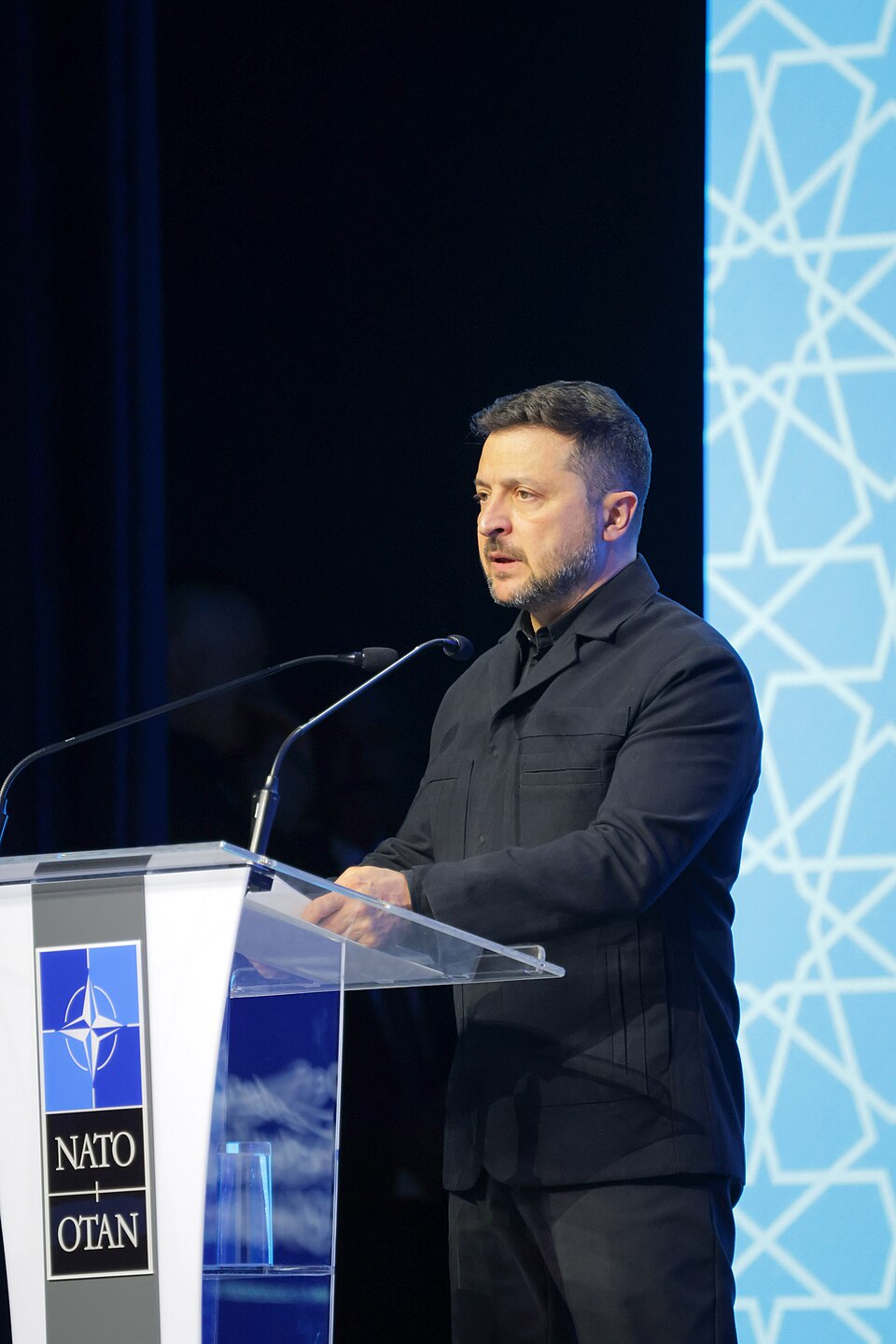
Archive photograph: Volodymyr Zelenskyy speaking at the NATO Summit in Ankara, 7 July 2026. NOT a photograph of his video address in Berlin on 23 November 2026. Photo: Dati Bendo / European Union, 2026. Cropped by website theme. CC BY 4.0. Original · CC BY 4.0.
 Додавайте "Україна Неймовірна" у свої джерела Google Новини