





















Ukraine’s domestically developed Blysk laser air defense system has shot down a Russian jet-powered Geran drone while protecting critical infrastructure.
According to Ukrainian presidential adviser on defense technologies Serhiy Beskrestnov, known as Flash, the interception marks the world’s first destruction of a jet-powered drone using a combat laser.
Beskrestnov released footage of the Ukrainian system in action on November 25, 2026.
From Ukrainian Engineering to Combat Deployment
Developed by Ukrainian defense company Carmine Sky, Blysk entered operational duty in early November 2026.
According to Militarnyi, the system has a reported power output of four kilowatts and a stated range of up to one kilometer.
Geran is the Russian designation for a family of attack drones derived from Iranian Shahed designs. Jet-powered variants travel considerably faster than conventional propeller-driven Shahed-type drones, making them more challenging to intercept.
How Ukraine’s Laser Fits Into Global Air Defense Development
The United States, the United Kingdom, Israel and several other countries are developing laser-based weapons.
In December 2025, Israel received its first Iron Beam system, developed by Rafael. The Israeli system has a reported power output of around 100 kilowatts.
Although the systems differ substantially in their specifications, Ukraine’s Blysk has already demonstrated its capabilities during a real-world defensive operation.
One of the potential advantages of laser-based systems is their lower cost per engagement. Rather than consuming a missile or conventional ammunition with every interception, they use electrical energy.
However, combat lasers require substantial development investments, while fog, precipitation and other atmospheric conditions can reduce their effectiveness. They are intended to complement conventional air defenses rather than replace them.
Ukraine’s Growing Defense Technology Sector
Ukraine first announced its Tryzub, or Trident, laser weapon in December 2024. Footage of the system undergoing trials was released in April 2025.
Another Ukrainian laser air defense system, Sunray, was publicly reported in February 2026.
According to Hromadske Radio, Carmine Sky says Blysk is an independent project unrelated to Tryzub.
Ukraine’s laser air defense technologies are being developed under the country’s Private Air Defense program with support from Brave1, its defense technology cluster.
Beskrestnov cautioned that it remains too early to discuss mass production. The systems are still undergoing operational testing while helping protect critical infrastructure, and Carmine Sky is developing additional laser systems.
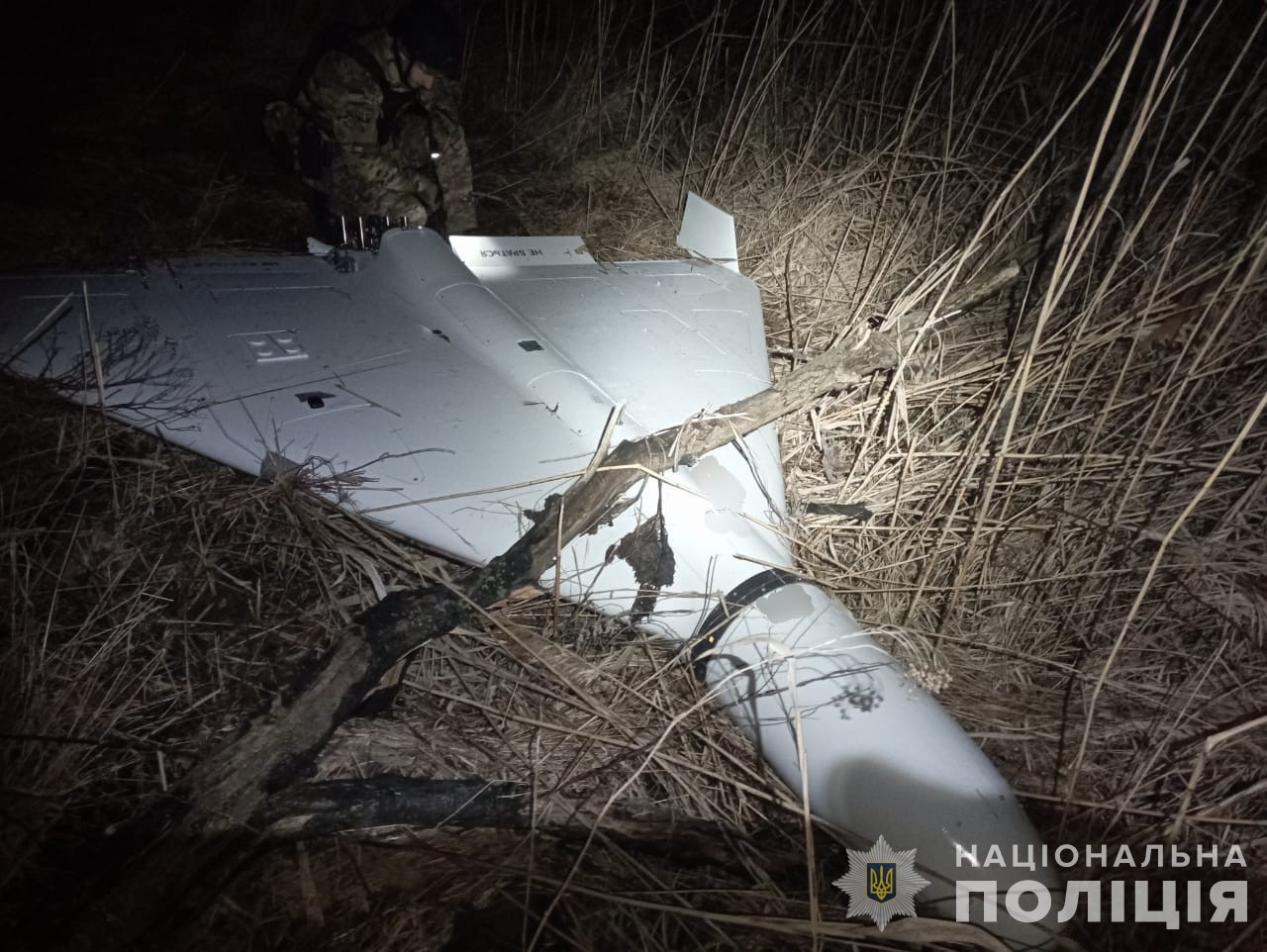
Archive illustration: a propeller-driven Russian Geran-2 drone brought down in Dnipropetrovsk region, February 9, 2024. Not the November 2026 interception. Photo: National Police of Ukraine (npu.gov.ua), CC BY 4.0. npu.gov.ua · Wikimedia Commons · CC BY 4.0
 Додавайте "Україна Неймовірна" у свої джерела Google Новини